
Building Science Notes
Is Your Brownstone Really Brownstone?
Walk down a block of Brooklyn brownstones and most of the brown you see is not stone. It is a brown-tinted cement coating, applied decades ago after the original sandstone began to flake off. Some houses on the same block were never brownstone at all: they are brick, with stone only at the trim.
This is not a scandal, and it does not make the house less worth caring for. But it matters the moment you plan a renovation. What is actually on the face of your building decides how the wall handles rain, which coatings are safe to use, and whether the wall can be insulated from the inside without trouble.
Four kinds of front
Houses that get called brownstones fall into four groups:
- Brick with stone trim. Many of the oldest rowhouses were always brick. The brownstone is at the lintels, sills, stoop, and the base of the house.
- Original brownstone front. A layer of sandstone four to six inches thick over a brick wall. The stone is a facing; the brick behind it is loadbearing. This was the fashion from the 1840s to the 1890s.
- Resurfaced front. The damaged outer surface of the stone was cut back to sound material and replaced with brown cement stucco, shaped to match the original details. Most of the original stone is still in the wall, behind the stucco. Conservators say this describes most "brownstone" fronts in the city today.
- Stripped or refaced. Before the Landmarks Preservation Commission existed, many contractors removed the brownstone down to bare brick or covered the facade with paint, stucco, or another stone.
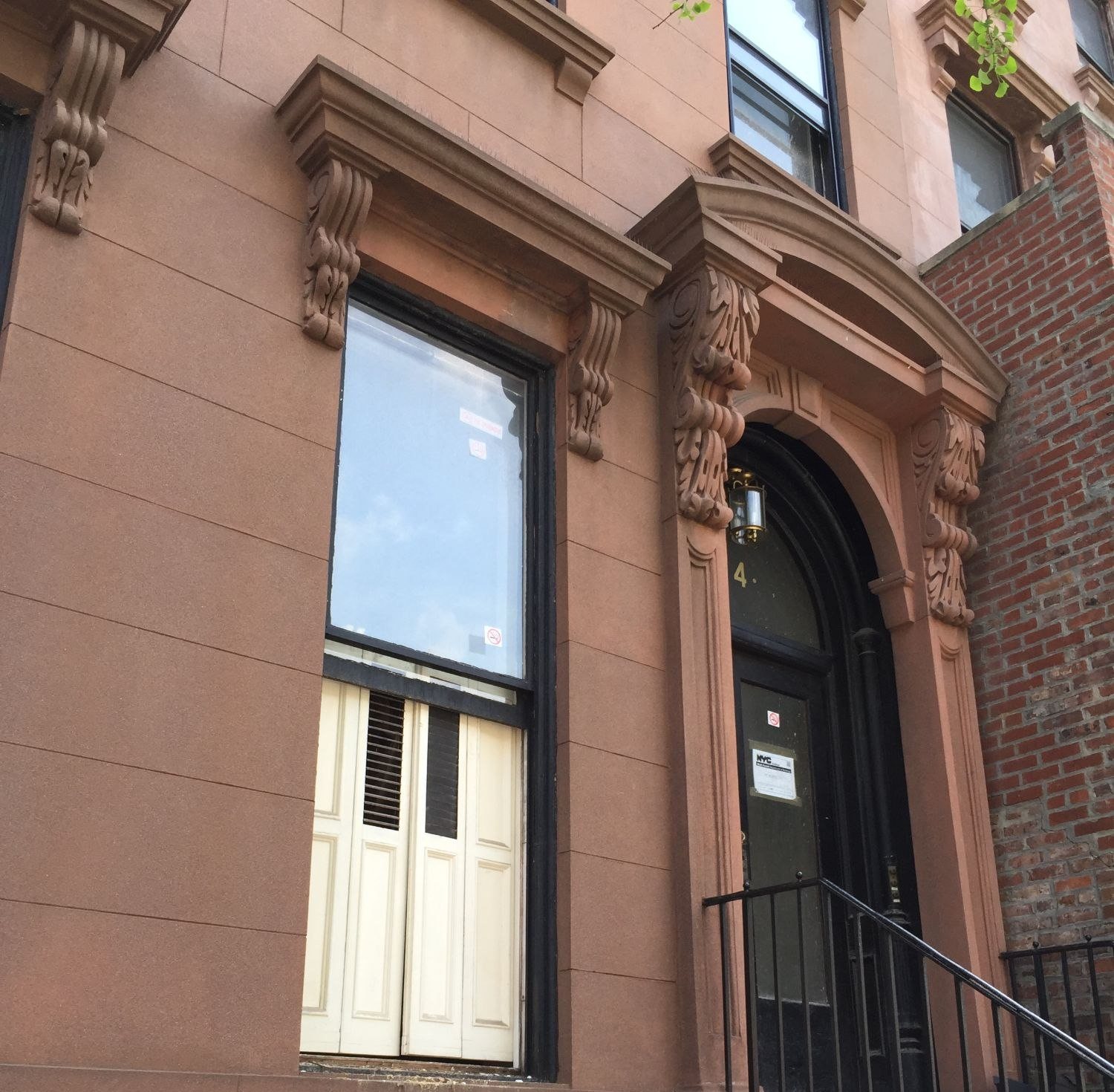
Why the stone failed
Brownstone is a soft sandstone, much of it quarried near Portland, Connecticut. It was often set on the building with its natural layers standing upright, parallel to the face of the wall. Water gets in between those layers, freezes, and pushes them apart. The face comes off in sheets.
That is why resurfacing became so common. It is also the same freeze-thaw problem described in our note on insulating old buildings.
How to tell what you have
- Look at the 1940s tax photos. The city photographed every building around 1940, and the Municipal Archives has the pictures. They show what the facade looked like before later changes and inform historic preservation work.
- Read the designation report. If the house is in a historic district, the Landmarks Commission's report describes the block building by building, often with a history of alterations.
- Read the trim. Brownstone lintels sitting in a brick wall usually mean the house was always brick. Ghost outlines or patched brick where lintels should be suggest the stone was stripped.
Why it matters for a renovation
Water control comes first. Before any insulation or coating, the leaks have to be fixed: failed pointing, parapet caps, and window sills. This is true for every one of the four types.
The proper coating depends on the surface material. A clear water repellent, a mineral paint, and an ordinary masonry paint behave very differently, and each one suits some surfaces and not others. Paint that forms a film can blister and pull the face off a wall that is holding moisture. A product chosen for stone may be wrong for cement stucco, and the other way around. Natural stone, for example, may be a candidate for a water repellent coating. Note that if the building is an individual landmark or in a historic district, a Landmarks Commission permit is required.
A repair has to suit what is already there. Since almost every front has been resurfaced once already, new work usually meets old stucco, not bare stone. A repair that is harder and less able to pass moisture than the material around it pushes the damage to that material. It is the same mistake as repointing soft old brick with hard modern mortar. So we look at the condition of the facade first, and then choose a repair that is compatible with the existing resurfacing.
It changes the insulation question. Insulating the inside of the front wall makes the wall colder and slower to dry. How much risk that carries depends on how much rain the face takes in, and that depends on what the face is made of and what condition it is in.
The takeaway
Find out what your front wall is made of before deciding what to put on it or behind it. An hour with old photographs and a careful look at the trim can change the plan for the whole wall.
We check the history and condition of the front wall at the start of every brownstone project. If you are planning work on one, get in touch before the scaffold goes up.
For architects: the short version
- Resurfacing method. The Landmarks Commission's rules describe it: cut the deteriorated stone back to sound material, then key in a tinted cement patching compound or build it up in layers with the top layer tinted, to match the original stone (LPC Rules, section 2-11(c)(4)(ii)).
- What the Commission prefers. Staff can permit patching, and resurfacing of select areas such as the stoop or base. A whole facade should not be resurfaced unless the Commission finds the brownstone in extremely poor condition (LPC Permit Guidebook, chapter 1).
- Materials, from most common to most conservative. Site-mixed cement stucco with pigment; a latex-modified cement system color-matched to the stone; a single-component mineral repair mortar made for brownstone; a natural hydraulic lime repair mortar.
- Our approach. It depends on the job. Almost all brownstone houses have been resurfaced already, so we evaluate the condition of the facade first and then determine what is compatible with the existing resurfacing.
- Clear water repellents. Case by case. Conservators disagree about using them on historic stone, and brownstone is one of the harder cases. Penetrating silane or siloxane products are the vapor-open choice; check the permeability of the specific product on the specific substrate. Measure water uptake on a test area before and after (a RILEM tube test). The Brick Industry Association's Technical Note 6A is the usual reference on colorless coatings. On a landmarked building a clear repellent is a coating and needs a staff permit. Staff approve it where water is getting in through a deteriorated surface, and it must be highly breathable, usually clear with a dull finish, and not a waterproofing product (section 2-11(c)(2)(iii)).
- Service life. One contractor, writing in the Journal of Light Construction in 2017, tells clients to expect about 15 years from a stoop resurfacing, longer with prompt repairs.